Frequencies Beneath the Surface: How Sound Artists Are Turning Water Into an Acoustic Instrument
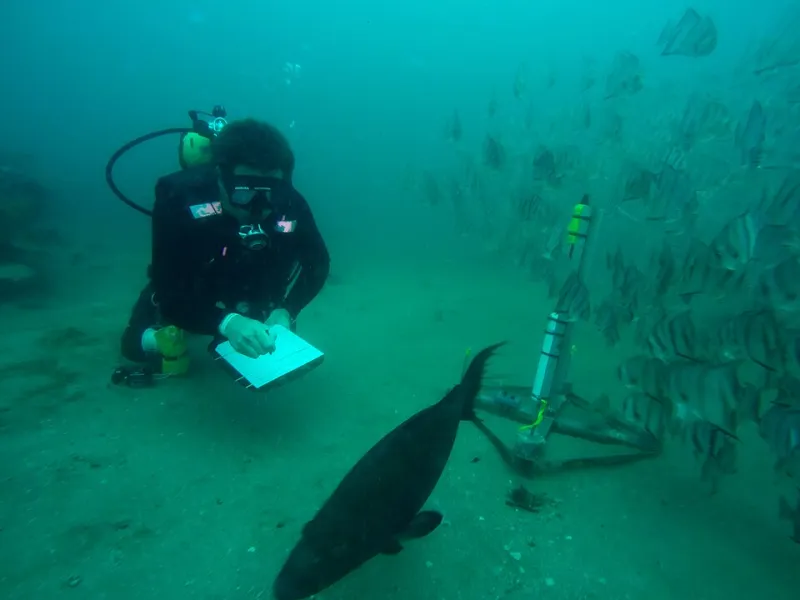
Photo: National Marine Sanctuaries, Public domain, via Wikimedia Commons
Water has always spoken. Long before the first canvas absorbed pigment or the first chisel met stone, rivers murmured through valleys, rain articulated itself against rock, and the ocean produced frequencies that traveled thousands of miles through the deep. For most of human history, however, those conversations were either too subtle, too low, or too structurally complex for our ears to fully comprehend. A growing cohort of contemporary sound artists working across the United States is now determined to change that — not by altering what water says, but by building the instruments necessary to finally hear it.
The results, appearing in galleries from Portland, Oregon to Miami's Wynwood arts district, are transforming how audiences experience both water and sound simultaneously.
The Hydrophone as Artistic Medium
At the center of this movement is a deceptively simple piece of technology: the hydrophone, an underwater microphone capable of capturing acoustic data across a far broader frequency range than standard recording equipment. Marine biologists have relied on hydrophones for decades to study whale communication and submarine geology. What sound artists have recognized, however, is that these instruments also function as aesthetic revelation devices.
Chicago-based sound designer Mariel Okonkwo has spent the past four years submerging hydrophones in the Chicago River at various points along its notoriously engineered course — a waterway famously reversed by the city in 1900. Her ongoing installation series, presented most recently at a gallery in the Pilsen neighborhood, plays back those recordings through a spatial audio system calibrated to fill an entire room. Visitors stand inside what amounts to an acoustic portrait of a river they have walked beside for years without truly hearing.
"People come in expecting something ambient, something peaceful," Okonkwo has noted in public discussions of the work. "What they encounter is complexity. Industrial vibration, biological activity, the structural resonance of bridges — the river is carrying all of it simultaneously. The hydrophone doesn't editorialize. It simply reports."
That commitment to reportorial fidelity distinguishes much of this practice from ambient music or sound art that merely evokes water through synthesis. The artists working in this space are insistent on using water itself as the primary instrument.
Algorithmic Composition and the Living Score
If hydrophones provide the raw material, algorithmic composition has emerged as the editorial framework through which many of these artists shape their work. Rather than selecting and arranging recorded segments manually, a number of practitioners are building software systems that respond to live acoustic data from water sources in real time, generating compositions that shift continuously as the water itself changes.
The Brooklyn-based collective Watershed Signal has installed one such system beneath the surface of a reflecting pool at a public cultural center in lower Manhattan. Sensors embedded in the pool's basin feed acoustic and motion data into a custom-built algorithmic engine, which translates that information into a musical score performed through speakers positioned around the perimeter. When visitors approach the pool and disturb its surface, the composition responds within milliseconds. The water becomes, in the most literal sense, a collaborative performer.
This approach raises productive questions about authorship that are central to contemporary art discourse. If the water is generating the score in real time, mediated only by a set of rules established by the artists, who is the composer? Watershed Signal has been deliberate about foregrounding that ambiguity in how they describe the work, insisting in their exhibition materials that the installation is not a representation of water but a collaboration with it.
Immersive Soundscapes and the Gallery as Aquatic Space
Beyond individual installations, a broader tendency toward full environmental immersion is reshaping how water-focused sound art is presented and received. Institutions including the San Francisco Museum of Modern Art and the Institute of Contemporary Art in Boston have hosted exhibitions in which entire gallery floors are given over to multi-channel audio environments derived from water sources — aquifers, storm drains, coastal tide pools, agricultural irrigation channels.
These immersive presentations are significant not only aesthetically but contextually. By surrounding a viewer with the acoustic reality of a specific body of water, often one threatened by industrial activity or climate change, artists create a form of intimacy with that water that conventional documentary or visual art rarely achieves. To stand inside the sound of a drying aquifer in the Central Valley of California is a qualitatively different experience from reading about its depletion.
Sound artist and composer Devraj Rao, whose work has appeared at public spaces along the National Mall in Washington, D.C., describes this intimacy as the central purpose of his practice. His installations draw on hydrophone recordings from American waterways documented over a fifteen-year period, layering those recordings into dense acoustic tapestries that reward extended listening. Visitors who remain in the space for thirty minutes begin to perceive details — a low structural hum, a rhythmic biological pulse — that are entirely invisible on first encounter.
"Water has a patience that we have largely abandoned," Rao has observed. "The work asks visitors to adopt that patience, at least temporarily. What they find when they do is a world that was always there."
Expanding the Audience Beyond Gallery Walls
Perhaps the most consequential development in water-focused sound art is its migration into public space. Outdoor installations in urban plazas, parks, and waterfront districts are bringing acoustic water experiences to audiences who would never enter a contemporary art gallery — and doing so with a directness that institutional settings cannot always replicate.
A recent commission along the Seattle waterfront placed a series of listening stations at intervals along the pier, each connected to hydrophones positioned at different depths in Puget Sound. Visitors wearing provided headphones could select a depth and listen in real time to whatever acoustic activity was occurring at that level of the water column. The installation drew consistent crowds over its three-month run, including substantial numbers of school groups whose teachers integrated it into science and environmental education curricula.
That crossover between artistic practice and scientific literacy is one of the more promising dimensions of this emerging field. By making water's hidden acoustic life accessible and compelling, these artists are doing something that neither pure science communication nor conventional environmental advocacy has consistently managed: they are making people genuinely curious about water as a living, complex system.
The sonic palette, it turns out, was always there. It simply required artists willing to listen carefully enough to share it.