Stagnant by Design: The Artists Weaponizing Still Water as Political Statement
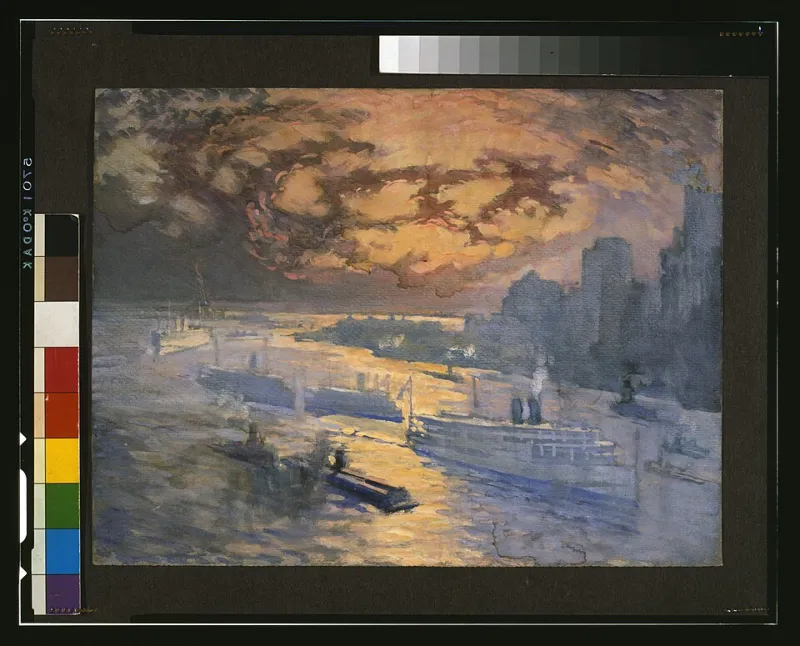
Photo: Pennell, Joseph, 1857-1926, artist, Public domain, via Wikimedia Commons
Water, in the dominant imagination of contemporary art, moves. It cascades, pulses, and refracts light in ways that feel instinctively alive. The visual language of water art has long privileged flow—the kinetic, the generative, the optimistic current. Yet a quieter, more unsettling counter-tradition is gathering force across American studios and exhibition spaces. A cohort of artists has turned their attention not to water in motion but to water arrested, sealed off, and deliberately left to stagnate. In their hands, the still pool becomes something far more confrontational than the serene surface it superficially resembles.
This is not accident or aesthetic preference. It is argument.
The Rhetoric of the Unmoving Surface
To understand why stillness functions as critique, one must first appreciate what contemporary culture projects onto flowing water. Rivers and streams carry associations of progress, renewal, and systemic health. When artists and municipalities celebrate water, they nearly always celebrate its movement—the restored creek, the revitalized waterfront, the fountain as civic symbol. Still water, by contrast, occupies a culturally anxious space. Stagnation connotes decay, neglect, and the failure of natural cycles. It is the condition of the forgotten drainage ditch, the neglected retention pond, the Superfund site left unremediated for decades.
Artists working in this vein are not arriving at stillness by accident. They are choosing it with precision, leveraging the discomfort it provokes to direct attention toward the very systems—environmental, governmental, social—that have themselves ceased to move.
Tamara Reyes, a mixed-media artist based in New Orleans, has spent the past four years constructing what she calls her "inertia series": large-scale contained pools installed in gallery settings and, on several occasions, in public spaces throughout the Gulf Coast region. Each pool is engineered to remain absolutely static. The water is sealed against evaporation, filtered to prevent biological activity, and lit from below so that visitors encounter a surface of absolute, mirror-like stillness.
"I want people to feel the wrongness of it," Reyes has said in public conversations about her practice. "We live next to the Gulf. Water is supposed to breathe. When it doesn't, something has failed. That failure is the piece."
The installations are disquieting precisely because they are beautiful. The reflective surfaces produce images of extraordinary clarity, doubling the gallery ceiling or the open sky above an outdoor venue. Viewers frequently pause at the edge, drawn in by the visual serenity before registering the absence of any sign of life. Reyes connects this experience directly to the post-Katrina landscape of her home region, where stalled federal response and incomplete environmental remediation have left entire ecosystems in suspension.
Green and Unmoving: Algae as Aesthetic Medium
Not all practitioners in this space work with clarity. A separate, arguably more visceral strand of the movement embraces biological stagnation—the turbid green of algae-bloomed water—as its primary visual register. Marcus Albright, a conceptual artist and environmental science graduate working out of Toledo, Ohio, has built an entire body of work around the aesthetics of harmful algal blooms.
Albright's installations recreate the visual conditions of Lake Erie's recurring toxic bloom events within contained gallery tanks. The work is deliberately difficult. The water is opaque, an aggressive and unsettling green-brown. Informational panels document the agricultural runoff patterns and regulatory failures that generate such conditions in the actual lake. Visitors are invited to consider the aesthetic object—the contained, carefully lit tank—alongside the political and ecological record it references.
"There is a tendency to treat environmental degradation as a policy problem and leave it there," Albright has noted. "What I am interested in is making people feel it as a sensory and aesthetic experience. The bloom is not a chart. It has a color, a texture, a smell. When you put it in a gallery, you are insisting that it belongs in the same conversation as beauty."
The Toledo connection is deliberate and pointed. In 2014, a harmful algal bloom on Lake Erie left the city of Toledo without safe drinking water for two days—an event that crystallized, for many residents, the human consequences of decades of agricultural and industrial policy decisions. Albright's work operates as a form of extended civic memory, refusing to allow that event to recede into abstraction.
Pools of Inaction: Climate Critique in Contained Water
The political valence of still water extends beyond specific regional crises. Several artists have used the contained pool as a metaphor for systemic climate inaction at the national level. Priya Sundaram, a sculptor and installation artist currently based in Chicago, creates works that directly visualize the gap between environmental policy commitments and measurable outcomes.
Her ongoing series, "Dead Reckoning," places identical pools in contrasting contexts: one representing a projected environmental future under current policy trajectories, one representing a restored baseline. The former is invariably still, clouded, or visually degraded. The latter moves—fed by a concealed recirculation system, clear, and biologically active. The contrast is not subtle, but Sundaram argues that subtlety has its limits as a political instrument.
"People have been receiving nuanced messaging about climate for thirty years," she has observed. "I am not interested in nuance at this particular moment. I am interested in legibility."
The series has traveled to venues in New York, Los Angeles, and Houston, drawing audiences that span both the contemporary art world and environmental advocacy communities—a crossover that Sundaram regards as central to the work's purpose.
The Aesthetics of Waiting
What unites these diverse practitioners is a shared conviction that the visual language of water art must expand to accommodate discomfort. The celebration of flow—however genuinely beautiful, however ecologically resonant—risks becoming a form of consolation, a reassurance that water persists and renews despite everything. Still water refuses that consolation. It insists on the possibility of failure, on the reality of systems that have stopped working and may not restart.
For audiences accustomed to encountering water art as a source of wonder and renewal, these installations can be genuinely destabilizing. That destabilization, the artists would argue, is the point. The still pool does not offer resolution. It holds the question open, surface unbroken, and waits for the viewer to decide what to do with the discomfort it produces.
In this sense, the movement is less about water itself than about the political conditions that surround it. Water is the medium, but stagnation—social, environmental, governmental—is the subject. And in the current American moment, that subject has no shortage of material.