Mirror, Distorted: How Water Artists Are Making America's Infrastructure Crisis Impossible to Ignore
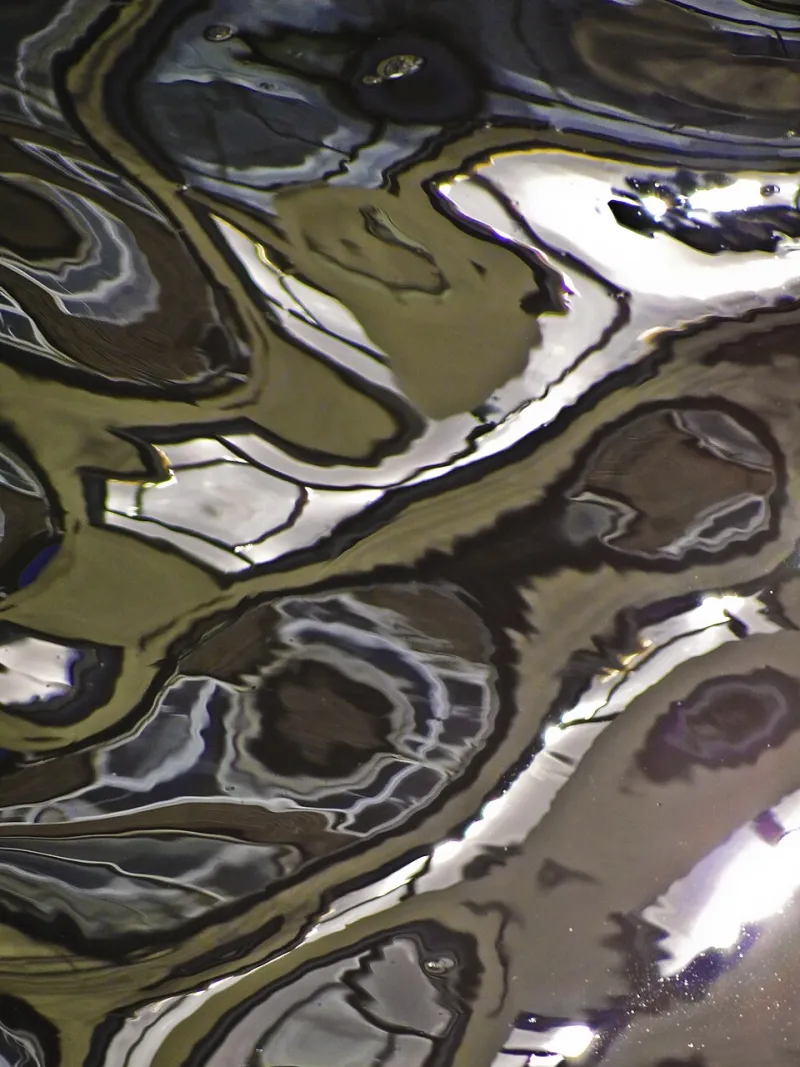
Photo: Wim Haverkamp, CC BY-SA 4.0, via Wikimedia Commons
There is a peculiar quality to a reflection that makes it simultaneously trustworthy and unreliable. We accept that a still surface of water shows us something true — our own face, the sky above, the structures around us — while simultaneously understanding that any disturbance, any angle, any impurity in the water itself will warp that truth into something less legible. Contemporary visual artists working at the intersection of water, reflective surface, and political critique have recognized in this instability an exceptionally precise metaphor for the condition of American water infrastructure: a system that presents the appearance of equity while concealing profound and often racialized disparity beneath its surface.
From a monumental outdoor installation in Detroit to a gallery intervention in the South Bronx, artists are using mirrors, still water pools, and deliberately corrupted reflective surfaces to make the invisible architecture of water injustice not merely visible but optically inescapable.
The Reflection as Political Argument
To understand why reflection functions so effectively as an artistic strategy in this context, it helps to consider what reflective surfaces actually do: they return an image of the viewer's environment to the viewer, implicating that viewer in the scene being depicted. When the reflective surface is water — particularly water that has been framed, colored, or chemically altered to evoke contamination — the implication becomes pointed. The viewer is not observing a problem from a safe distance. They are standing inside it.
Detroit-based artist Camille Reyes has built her practice around precisely this dynamic. Her installation Distributed, which occupied a former industrial site in Detroit's North End neighborhood for eight weeks, consisted of a series of shallow rectangular pools arranged in a grid pattern across the site's concrete floor. Each pool contained water sourced from a different zip code in the Detroit metropolitan area, with no chemical alteration applied. The visual differences between pools — some clear, some cloudy, some bearing a faint but unmistakable discoloration — were the result of the water itself, drawn directly from the taps and wells of communities that exist within miles of one another but receive demonstrably different water quality.
Visitors moving through the installation encountered their own reflections in each pool in turn, their images shifting in clarity and color as they progressed from one water source to the next. The experience of watching your own face become progressively less distinct in increasingly compromised water was, by multiple accounts, difficult to dismiss as abstract or theoretical.
"I didn't want to make an argument," Reyes has explained in interviews. "I wanted to make a condition. The argument, if there is one, is made by the water."
Distortion as Documentary Practice
Where Reyes works with unaltered water to produce her effects, other artists have developed more formally complex approaches to distortion as a documentary and critical tool. Los Angeles artist and designer Marcus Thinh-Nguyen has produced a body of work in which large-format mirrors are deliberately warped, cracked, or coated with materials that mimic the visual signature of water contaminated by specific industrial pollutants — the iridescent sheen of petroleum, the chalky opacity of elevated lead content, the rust-orange tinge associated with corroded iron pipes.
Thinh-Nguyen's mirrors are installed at eye level in gallery spaces and, in several cases, on exterior walls in communities directly affected by the contamination events his materials reference. Viewers approaching these surfaces encounter reflections of themselves and their surroundings rendered in the visual language of pollution. The effect is not naturalistic — the distortion is clearly artificial — but that artificiality is itself part of the argument. The mirrors make visible a contamination that, in the communities where they are installed, was rendered invisible for years by official reassurances and inadequate monitoring.
A recent commission for a community organization in Compton, California placed one of Thinh-Nguyen's large-format contamination mirrors on the exterior wall of a neighborhood community center. Residents who had lived through years of documented groundwater contamination in the area found in the installation a form of acknowledgment that official communications had rarely provided. The mirror did not explain the contamination or advocate for a specific policy response. It simply reflected the neighborhood back to itself in the visual grammar of what had been done to its water.
Infrastructure Made Optical
A third strand of this practice focuses less on the visual properties of contaminated water and more on the structural invisibility of water infrastructure itself — the pipes, treatment facilities, pumping stations, and distribution networks that most Americans never see and rarely consider until they fail.
New York-based collective Conduit Arts has developed a series of installations in which mirrors are positioned to create infinite reflection corridors that reference the visual experience of looking down a long pipe or tunnel. Within these corridors, the collective introduces water elements — drips, flows, still pools — that interrupt and complicate the reflective geometry. The effect is disorienting in a way that is also, the collective argues, epistemically accurate: most people have no coherent mental image of the infrastructure that delivers their water, and the installations make that cognitive gap a felt experience rather than an abstract admission.
A version of this installation, presented at a gallery in Brooklyn in collaboration with a local environmental justice organization, incorporated actual pipe sections from infrastructure replacement projects in the borough, some bearing visible corrosion and mineral buildup. The juxtaposition of deteriorated physical infrastructure with its infinite optical reproduction produced what several reviewers described as a genuinely vertiginous encounter with the gap between civic assumption and material reality.
Rendering the Systemic Visible
What unites these varied approaches — unaltered water in comparative pools, contamination-coded distortion mirrors, infrastructure-referencing reflection corridors — is a shared conviction that the systemic nature of water inequity in America is itself a form of concealment. Systems are, by definition, distributed and invisible; their effects are experienced locally and individually, which makes their structural causes difficult to perceive and therefore difficult to contest.
By using the mechanics of reflection and distortion to make those systems optically present, these artists are doing something that policy reports and advocacy campaigns have consistently struggled to accomplish: they are giving viewers an embodied, immediate, and aesthetically compelling experience of a problem that is otherwise almost entirely abstract.
The mirror, in this context, is not a passive surface. It is an argument, a disclosure, and an invitation to look more carefully at what is being reflected — and at what, in the absence of art willing to make it visible, would remain entirely beneath the surface.