Where Water Becomes the Plaza: 12 Public Water Installations Redefining American Urban Space
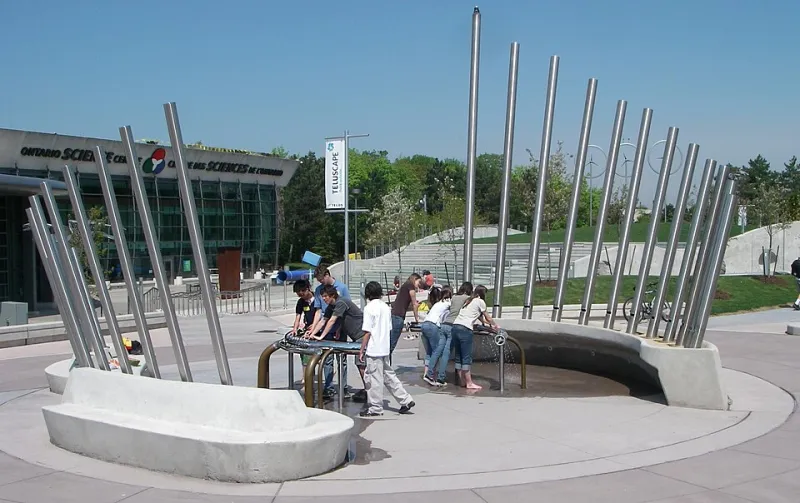
Photo: Original uploader was Glogger at en.wikipedia, CC BY-SA 3.0, via Wikimedia Commons
For most of the twentieth century, the public fountain occupied a peculiar cultural position in the American city. It was civic furniture—present, functional, largely ignored. People tossed coins. Pigeons gathered. The water ran on a timer. Then, gradually, something shifted. Artists, urban planners, and municipal governments began to ask a different question: not "Where do we put the fountain?" but "What can water do to a public space that nothing else can?"
The answers, arriving now from cities across the country, are reshaping plazas, waterfronts, and transit hubs in ways that blur every useful boundary between art, architecture, infrastructure, and community gathering. What follows is a survey of twelve installations that represent the leading edge of this transformation.
1. Crown Fountain, Chicago, Illinois
No list of this kind begins anywhere else. Jaume Plensa's monumental video installation at Millennium Park remains, two decades after its 2004 debut, the most influential example of water as participatory civic art in the United States. Two fifty-foot glass brick towers display the faces of Chicago residents in slow, contemplative rotation—and at intervals, water cascades from a spout at the mouth of each face, inviting children and adults alike to wade in the shallow reflecting pool below. It transformed what might have been a formal garden feature into one of the most democratic public spaces in any American city.
2. Waterfire, Providence, Rhode Island
Barnaby Evans's ongoing installation series along the Woonasquatucket and Moshassuck Rivers is less a single work than a recurring civic ritual. Braziers mounted on the surface of the river are set alight after dark while gondoliers move through the water and ambient music fills the air. Waterfire has become so central to Providence's cultural identity that the city has built its event calendar around it—a remarkable example of an art project becoming genuinely indispensable infrastructure.
3. The Frog Pond, Boston Common, Massachusetts
What began as a simple wading pool on the oldest public park in America has evolved, through a series of thoughtful interventions, into a seasonally adaptive water installation that serves the community in radically different ways across the year. In summer, misting jets and interactive spray elements engage children. In winter, the pond converts to a skating rink. The transitions themselves have become a kind of installation—a water-based calendar that marks the city's seasons in public.
4. Bioluminescent Tide Pool Installation, San Francisco, California
Installed along the Embarcadero as part of a temporary public art initiative, this project used chemiluminescent compounds in sealed water channels embedded in the pier surface to simulate the bioluminescent tidal pools found along the Northern California coast. Visitors walking the waterfront at night activated the glow through motion sensors embedded beneath the channel covers. The installation was deliberately temporary—its impermanence was part of its argument about the fragility of the coastal ecosystems it evoked.
5. Klyde Warren Park Water Feature, Dallas, Texas
Built atop a freeway deck in downtown Dallas, Klyde Warren Park represents a broader urban design ambition—the reclamation of hostile infrastructure as public green space—and its central water feature is central to that reclamation. The shallow splash pad and adjacent water garden serve a population that otherwise has limited access to water recreation in a landlocked, heat-intensive urban environment. On summer afternoons, it functions as the most democratic cooling system in the city.
6. Sound-Reactive Water Wall, Discovery Green, Houston, Texas
Houston's Discovery Green has long been one of the more ambitious examples of programmed urban park design in the American South, and its sound-reactive water wall installation advances that ambition considerably. Microphones embedded in the surrounding plaza capture ambient sound—conversation, music from nearby events, traffic—and translate it into variations in water flow, pressure, and direction along a forty-foot vertical surface. The result is a work that is never the same twice, shaped in real time by the community that surrounds it.
7. Reflecting Absence, National September 11 Memorial, New York City
Michael Arad and Peter Walker's design for the memorial pools at Ground Zero is, among many other things, a profound meditation on water as a medium for grief. Two vast reflecting pools occupy the footprints of the original towers, their water falling continuously into a central void. The sound of the water—present, persistent, impossible to ignore—creates an acoustic environment that separates the memorial from the surrounding city. It is perhaps the most emotionally precise use of water in any American public space.
8. The Waterwall, Houston, Texas
The sixty-foot curved fountain at the Williams Water Wall in Houston's Uptown district is, on one level, simply impressive engineering—186 arched openings through which 11,000 gallons of water circulate per minute. On another level, it is a study in how sheer scale can transform a utilitarian water feature into an immersive environment. Visitors do not merely observe the Waterwall; they enter its acoustic field, feel its mist, and experience a shift in atmosphere that the surrounding landscape cannot produce.
9. Interactive Mist Walk, Lurie Garden, Chicago, Illinois
Within the larger ecology of Millennium Park, the Lurie Garden's seasonal mist installation offers a more intimate counterpoint to the Crown Fountain's spectacle. Low-lying mist jets activated by visitor movement create a shifting, semi-transparent environment at ground level, softening the boundary between the garden's perennial plantings and the bodies moving through them. In the early morning, before the park fills, it produces an atmosphere that is genuinely otherworldly.
10. The Vessel Waterfront Activation, Hudson Yards, New York City
The controversial Vessel structure at Hudson Yards has been more discussed for its design debates and safety concerns than for its water elements, but the surrounding waterfront activation—which includes a series of interactive water channels and tidal reference markers embedded in the plaza surface—represents a more considered engagement with water as urban material. The tidal markers, in particular, offer visitors a visceral connection to the Hudson River's rhythms that the building itself, for all its ambition, cannot.
11. Luminous Water Garden, Atlanta Beltline, Georgia
Installed along a stretch of the Atlanta Beltline trail system, this solar-powered installation uses fiber-optic elements integrated into a series of shallow water channels to create a light-and-water pathway that activates at dusk. The project was conceived explicitly as a safety and activation initiative for a trail section that had seen limited evening use—demonstrating that water art in public space can serve simultaneously aesthetic, social, and practical functions.
12. Rain Room Touring Installation (Various US Venues)
Random International's Rain Room—a field of falling water that pauses wherever a human body is detected, creating a dry path through the rain—has toured major American institutions including MoMA in New York and the Curve Gallery at the Barbican's US partner venues. Its impact on audiences has been consistently and somewhat remarkably emotional: the experience of standing in rain that will not touch you produces, in most visitors, a response that exceeds what the technical description would suggest. It is, at its core, a work about human relationship to water—about the desire to be near it, and the instinct to be protected from it.
Water as the New Commons
What connects these twelve projects, across their considerable differences of scale, medium, and intent, is a shared understanding of water as a social technology. Each installation uses water's particular properties—its sound, its movement, its temperature, its light-refracting capacity—to do something that static public art rarely achieves: it draws people into active, embodied relationship with a shared space.
At Aqua Mosaics, we believe that the most important water art is not the kind that hangs behind glass. It is the kind that gets your shoes wet, that changes the sound of the street, that makes you stop walking and look up. The projects surveyed here are, in their best moments, exactly that: not decorations for the city, but arguments about what the city is for.