Color as Testimony: The Artists Mining Water Sources for Pigments That Remember
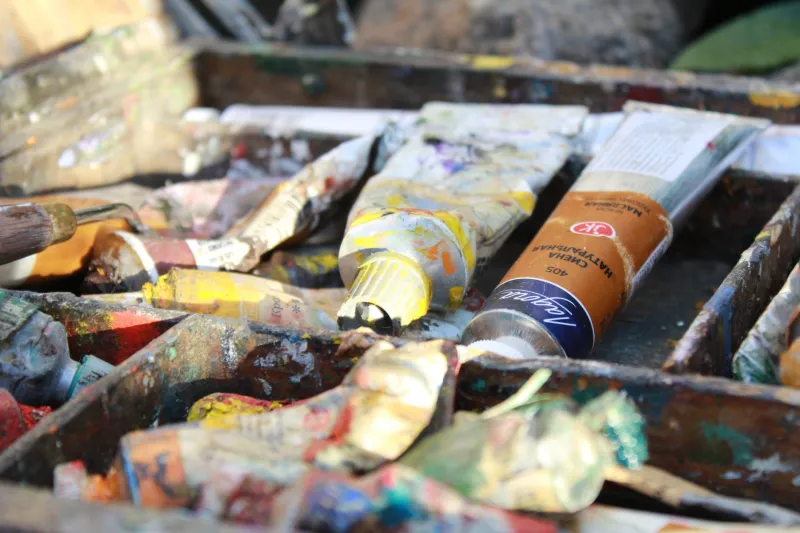
There is a long tradition in Western painting of sourcing color from the earth—ochres pulled from clay, lapis dissolved from stone, verdigris coaxed from corroded copper. What a new generation of American artists is doing feels simultaneously ancient and urgent: they are going to the water, and what they bring back is not merely pigment. It is evidence.
Across studios from Appalachia to the Salton Sea, artists are harvesting iron oxide from rust-stained creek beds, processing mineral residue from mine drainage, and cultivating natural dyes from algae blooms in eutrophic lakes. The colors they produce are specific to place and moment. They cannot be replicated by a manufacturer, and they cannot be separated from the histories that created them.
The Chemistry of Consequence
When acid mine drainage flows through a stream, it deposits iron hydroxide—a vivid, ochre-orange sediment colloquially known as yellow boy. For decades, environmental scientists have studied this material as an indicator of industrial contamination. Artists working in the Appalachian coalfields have begun collecting it deliberately, processing it into stable pigments, and applying it to paper and canvas with the precision of documentarians.
The resulting works are not protest posters. They are something more ambiguous and, arguably, more powerful: paintings that carry the literal chemical signature of extraction industries within their surface. The orange of a contaminated tributary in southwestern Pennsylvania is not the orange of cadmium or saffron. It is geologically and historically specific. It says: this water passed through a particular seam of coal, in a particular valley, at a particular moment in the long aftermath of industrial use.
This specificity is the point. When the color itself becomes the argument, the viewer cannot easily dismiss it as interpretation or exaggeration. The pigment is the record.
Algae, Mineral, Memory
Iron oxide is only one entry point. Artists working with water-sourced pigments are drawing from an extraordinarily wide material vocabulary.
In the Great Lakes region, some practitioners have turned to the cyanobacteria that proliferate during toxic algal blooms—harvesting dried biomass, extracting its blue-green pigment, and using it in works that address agricultural runoff and the slow eutrophication of freshwater systems. The color is striking: a muted, complex teal that reads as simultaneously beautiful and wrong, a visual register that mirrors the bloom's own contradictory nature as both natural phenomenon and human-caused crisis.
Others have worked with the mineral-laden groundwater of the American Southwest, where aquifers carry dissolved calcium, manganese, and arsenic in concentrations that reflect both geological history and decades of industrial agriculture. The precipitates from this water—collected through slow evaporation and careful filtration—yield whites and pale grays that seem almost clinical until their origins are understood. At that point, the pallor becomes something else entirely.
In Louisiana, artists have collected sediment from waters affected by petrochemical discharge, producing deep blacks and dark umbers that register differently once a viewer knows their source. The color of crude is not merely a visual fact; it is a historical one.
Painting as Archaeological Practice
What unites these approaches is a fundamental reconception of what it means to make a painting. The traditional model separates the artist from the material: pigments are manufactured, standardized, and delivered. The artist's contribution is formal—composition, mark-making, conceptual intent. The materials are, in a sense, neutral.
When pigment is extracted from a contaminated source, that neutrality dissolves. The material arrives already laden with meaning it did not choose. The artist's role shifts from creator to interpreter—or more precisely, to archaeologist. The act of preparing pigment from a water source requires the same careful attention to provenance, documentation, and chain of custody that defines responsible archaeological practice. Where was this water collected? At what depth? During what season? What industrial or agricultural activity occurs upstream?
These questions are not incidental. They are constitutive of the work itself. Several artists working in this mode maintain detailed field notebooks alongside their studio journals, recording water temperature, pH levels, and GPS coordinates with the same rigor they bring to compositional decisions. The documentation is part of the artwork.
The Question of Aesthetics
A reasonable challenge to this practice asks whether the conceptual framework risks overwhelming the visual experience. If a painting's primary significance lies in the story of its pigment's origin, does the painting itself become secondary—a vehicle for information rather than a work of art?
The most compelling works in this emerging field resist that reduction. The artists most deeply engaged with water-sourced pigments tend to be skilled colorists who understand that the material's origin does not exempt it from the demands of visual intelligence. A painting made with mine drainage orange still has to function as a painting. The fact that its color is a chemical record does not release it from the obligation to hold a viewer's attention through form, scale, and surface.
In fact, the best of these works use the tension between beauty and contamination as their central formal problem. The orange is gorgeous. It is also toxic. The viewer holds both facts simultaneously, and the discomfort of that coexistence is precisely where the work lives.
A Living Archive
There is one further dimension to this practice that distinguishes it from more conventional documentary art: the materials are unstable in ways that manufactured pigments are not.
Water-sourced pigments, particularly those derived from biological sources like algae, may shift over time—fading, oxidizing, or reacting to light and humidity in ways that synthetic alternatives would not. Some artists embrace this instability deliberately, understanding it as a continuation of the water's own temporality. A painting that changes as its pigment ages is a painting that keeps testifying. It does not freeze the moment of its making; it extends it.
This approach places these works in an interesting dialogue with the broader conversation about impermanence in contemporary art. The painting is not a fixed record but an ongoing one—a chromatic archive that remains open, subject to revision by the same chemical forces that created it.
In a cultural moment when the condition of American waterways is increasingly contested—politically, legally, and ecologically—there is something significant about an artistic practice that refuses to let water be merely a subject. These artists insist that water is also an author, and that its testimony, rendered in color on a surface, deserves to be read with the same seriousness we bring to any historical document.