Held Underwater, Held Together: How Submersion Is Becoming a Radical Act of Cultural Preservation
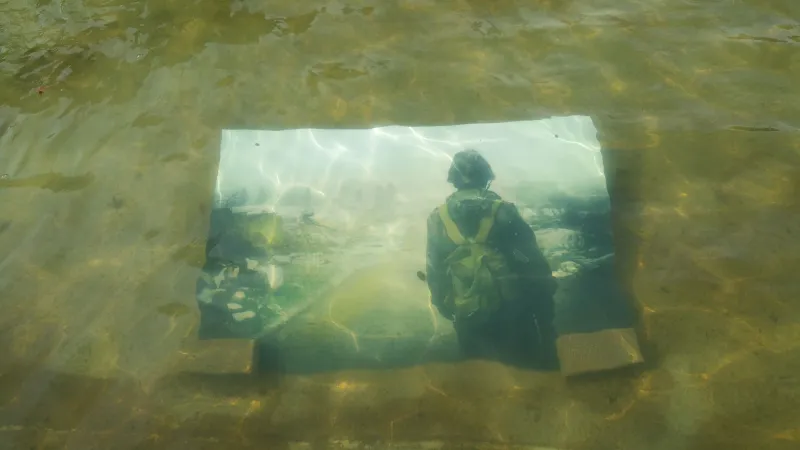
There is something deeply counterintuitive about placing a photograph in water to protect it. Water stains. Water warps. Water erases. And yet, a compelling strand of contemporary American conceptual art is doing precisely that—submerging the fragile remnants of threatened histories beneath glass tanks, tidal pools, and purpose-built aquatic chambers in order to preserve not the objects themselves, but the attention those objects demand.
This is the central tension driving a new wave of water-based installation work: the deliberate deployment of water's destructive reputation as a kind of radical curatorial strategy. By placing what is vulnerable inside what is dangerous, these artists manufacture a viewing experience that is impossible to approach casually.
The Archive That Cannot Be Touched
In conventional preservation practice, distance is protection. Museum-goers stand behind velvet ropes. Archivists wear cotton gloves. The logic is straightforward: separation extends longevity. But artists working in the submersion tradition are inverting this logic entirely. They are using water—with all of its visual distortion, its weight, its historical association with flood and loss—to create a new kind of intimacy with imperiled material.
Consider the effect of viewing a handwritten letter through several inches of still water. The text becomes slightly illegible, the edges soft. The viewer must lean in. They must look harder. The act of reading, which we perform automatically and without ceremony in daily life, becomes a deliberate, almost devotional exercise. The water does not simply sit between viewer and object; it insists on the significance of what lies beneath it.
This is, at its core, a pedagogical gesture. The artists engaged in this practice are not merely making aesthetic choices. They are designing conditions under which an audience is forced to confront the precarity of cultural memory—and to ask, with some discomfort, why certain stories have been allowed to approach the edge of disappearance in the first place.
American Histories at the Waterline
The practitioners working most rigorously in this space tend to draw on histories that the dominant American cultural archive has treated with neglect or active suppression. Indigenous land documents, letters written in languages no longer widely spoken, photographs from communities displaced by dam construction, deeds and records from neighborhoods erased by urban renewal projects—these are the kinds of materials appearing in submersion-based works across galleries and public installations throughout the United States.
The choice of subject matter is not incidental. Water, in many of these histories, is itself the agent of displacement. The Tennessee Valley Authority's mid-twentieth-century dam projects submerged entire towns and cemeteries. The flooding of the Elwha River valley displaced Indigenous communities whose relationship to that watershed stretched back thousands of years. By placing documents from these histories into water, artists are completing a kind of terrible circle—while simultaneously refusing the finality that circle implies.
The submerged object becomes a survivor. It is still there. You can still see it. The water around it is not a grave but a vitrine, and the distinction matters enormously.
Distortion as Disclosure
One of the most formally compelling aspects of submersion-based installation is the way water transforms what it holds. Refraction bends lines. Surfaces ripple and shift with ambient vibration. A document that appears legible from one angle becomes obscured from another. Artists working in this mode have spoken extensively about their deliberate use of this instability—not as a flaw to be engineered around, but as a central feature of the work's meaning.
If the cultural record has always been distorted by power—by who controlled the printing press, the courthouse, the archive—then a distorted view through water is, in a sense, an honest representation of how that record has been transmitted. The viewer who struggles to read a submerged text is experiencing, in miniature, the effort required to access histories that were never meant to be easily found.
Some installations incorporate lighting designed to shift over the course of a gallery visit, so that the legibility of submerged material changes with the time of day. Others use saline solutions of varying densities to create visual layering effects. A few practitioners have introduced slow-moving currents into sealed tanks, so that the objects within drift almost imperceptibly—present, but never entirely still.
Preservation as Performance
There is also a durational dimension to this work that distinguishes it from more static forms of archival art. Submersion, even in carefully controlled conditions, is a process. Objects change slowly over the course of an exhibition. Paper softens. Ink migrates. The artifacts that emerged from the water at the end of a months-long installation are not the same as the ones that entered it. This temporal arc is, for many of these artists, the point.
Preservation, in the conventional sense, aspires to stasis. The archivist's goal is to stop time, to hold an object in a state as close to its original condition as possible. Submersion-based art refuses this aspiration. It acknowledges that cultural memory is not static—that it changes in the telling, that each generation encounters inherited histories differently, that the act of preservation is itself transformative. The work does not pretend to rescue these materials from time. It stages their encounter with time as an event worth witnessing.
For American audiences accustomed to the mythology of the permanent collection—the idea that what enters a museum stays, unchanged and authoritative, forever—this is a genuinely disorienting proposition. It asks whether the goal of preservation should be to freeze a history or to keep it alive, even at the cost of some alteration.
What We Choose to Submerge
Perhaps the sharpest question these works pose is one of selection. Every submersion installation begins with a curatorial decision: this, and not that. These letters, these photographs, these particular fragments of a larger, mostly lost record. The artist must choose what enters the water, and in choosing, they make visible the fact that all preservation involves choice—and that choice is never neutral.
In a cultural moment defined by heated debates over whose histories belong in public institutions, whose names appear on monuments, and whose stories are deemed worthy of federal archival resources, the submersion installation operates as a pointed intervention. It does not argue for a particular historical narrative so much as it insists on the stakes of the argument itself. The water holds what someone decided was worth holding. Everything else is somewhere else, or nowhere at all.
At Aqua Mosaics, we have long understood water as a medium that carries meaning far beyond its physical properties. In the hands of these artists, it becomes something more specific still: a container for the things we are not yet sure we are allowed to remember, held just below the surface, waiting for someone to look closely enough to read them.