Suspended in Splendor: How High-Speed Water Droplet Photography Is Redefining the Edge Between Accident and Intention
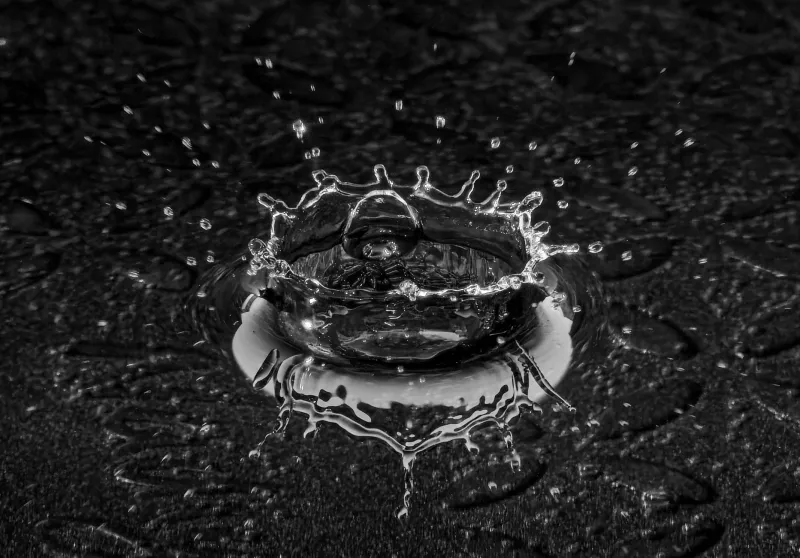
There is a moment — measured not in seconds but in microseconds — when a falling droplet of water meets a still surface and erupts into a crown of liquid architecture. No sculptor's chisel, no painter's brush, no digital rendering engine could fabricate what occurs in that instant. The form is real, it is physical, and it is gone before the human eye can register it. Yet a growing community of artists has dedicated years of practice, thousands of failed frames, and considerable philosophical inquiry to capturing precisely this moment — and in doing so, has transformed a technical exercise into one of the more compelling fine art conversations happening in contemporary photography today.
At Aqua Mosaics, where water is understood as both medium and message, this discipline occupies a singular position. It is the place where scientific instrumentation meets aesthetic vision, where the camera becomes not merely a recording device but a collaborator in the act of creation.
The Architecture of an Instant
High-speed water droplet photography operates on a deceptively simple premise: release a droplet, trigger a flash at the precise moment of impact, capture the resulting form. In practice, the process demands an almost obsessive calibration of variables. The height of the drop, the viscosity of the liquid, the surface tension of the receiving pool, the millisecond timing of the flash — each element contributes to the final composition in ways that are partially predictable and partially beyond any artist's absolute command.
This interplay between calculation and surrender is precisely what draws serious practitioners to the discipline. German photographer Markus Reugels, widely regarded as one of the foremost figures in the field, has spent years refining his methodology to produce images that appear almost impossibly deliberate — liquid columns that bifurcate into symmetrical crowns, droplets suspended mid-collision in formations that recall modernist sculpture. His work does not merely document physics; it frames physics as aesthetic language.
What distinguishes Reugels and artists working in his tradition from simple technical demonstrators is the degree to which compositional intent shapes every decision prior to the shutter release. Color, achieved through dyes introduced into the water or through strategic backlighting, transforms transparent liquid into saturated form. The angle of the camera, the choice of background, the diameter of the nozzle — these are the decisions of an artist constructing a visual argument, not a scientist running an experiment.
Chance as Co-Author
Yet for all the preparation, something irreducibly accidental persists at the core of every image. No two droplet collisions produce identical results. The turbulence introduced by a previous drop, a microscopic variation in the release mechanism, a slight change in ambient temperature — any of these can alter the resulting form in ways no artist can fully anticipate. This is not a flaw in the process. For many practitioners, it is the entire point.
Contemporary art has long been preoccupied with the productive tension between control and contingency. From John Cage's chance compositions to the drip paintings of Jackson Pollock, American art history is threaded with artists who understood that relinquishing absolute authority over an outcome could produce results richer than pure intention alone. Water droplet photography belongs to this lineage, though it arrives through an entirely different technical apparatus.
Emerging artists working in this space — many of them self-taught, building custom rigs in home studios across the United States — speak frequently about the meditative quality of the work. The process requires patience measured in hundreds of discarded frames. Success, when it arrives, carries the particular satisfaction of having created the conditions for something beautiful to happen, rather than having manufactured beauty directly. The distinction matters to them, and it should matter to audiences as well.
The Invisible Made Legible
One of the defining preoccupations of contemporary visual art is the desire to make perceptible what ordinarily escapes human perception. Whether through long-exposure night photography, electron microscopy imagery, or data visualization, artists across disciplines are reaching toward the hidden architecture of the world. High-speed water droplet photography participates in this broader cultural impulse with particular elegance.
Water is among the most familiar substances in human experience. We drink it, bathe in it, stand before it on coastlines and riverbanks and assume we understand it. High-speed photography reveals that we understand almost nothing about what water actually does at the scale of milliseconds and millimeters. The crowned splash, the rebounding column, the secondary droplet that rises from the impact site like a small eruption — these are not poetic inventions. They are literal events occurring in every kitchen sink and rainstorm, invisible only because human vision is too slow to register them.
When an artist presents these forms in a gallery context — printed large, lit deliberately, framed with curatorial intention — the effect is one of genuine revelation. Audiences encounter a familiar substance made strange, and in that estrangement, a space opens for genuine contemplation.
Technical Mastery as Artistic Vocabulary
It would be a mistake to underestimate the technical demands of this discipline or to treat them as separate from its artistic dimensions. In water droplet photography, technical mastery is not a precondition for art-making — it is the art-making. The photographer who understands precisely how to modulate flash duration to freeze motion at one-ten-thousandth of a second, who knows how the addition of guar gum to water will increase viscosity and alter the shape of the resulting crown, who can predict with reasonable confidence how a two-drop sequence will interact — this photographer possesses a vocabulary unavailable to those who have not invested in that understanding.
Several American photographers have begun exhibiting this work in gallery settings, arguing persuasively that the technical labor embedded in each image is itself a form of artistic statement. In an era of generative imagery and algorithmic design, the insistence on physical process — on actual water, actual physics, actual time — carries a distinct cultural weight.
A Medium That Refuses Stillness
There is something philosophically resonant about an art form devoted to capturing what cannot, by its nature, hold still. Water droplet photography is, at its most fundamental level, a practice of making permanence from impermanence — of insisting that the ephemeral deserves to be seen, studied, and preserved.
This is territory that Aqua Mosaics finds deeply familiar. The artists who work with water in all its forms — those who paint with it, build with it, record its sounds, map its absence — share a common understanding that water's resistance to fixity is not an obstacle to artistic engagement but its richest invitation. High-speed droplet photography simply pursues that invitation at a scale invisible to the naked eye.
What the best work in this discipline ultimately offers is not a record of what water looks like, but a proposal about what attention itself can accomplish — and what wonders become available when an artist is willing to slow down time long enough to look.