Shattered and Whole: How Water's Refractive Power Is Rewriting the Rules of Visual Truth
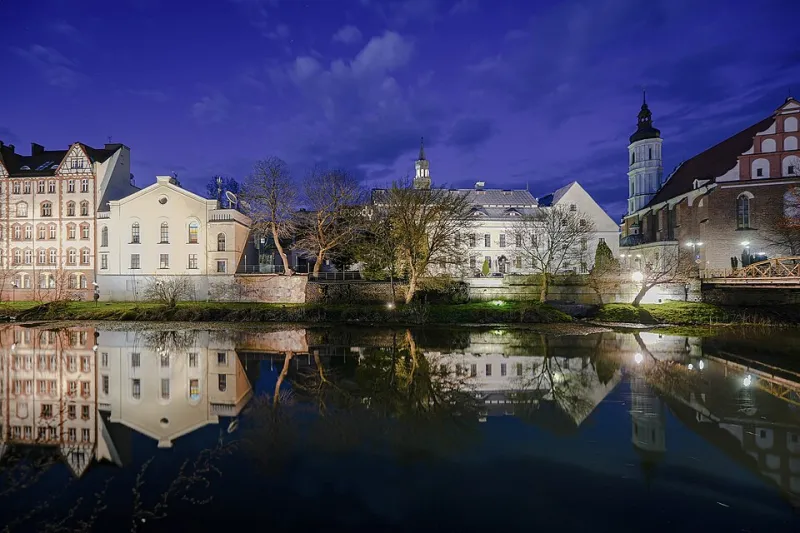
Photo: Krzysztof Popławski, CC BY 4.0, via Wikimedia Commons
There is a moment, familiar to anyone who has ever looked into a disturbed pool, when a face or a skyline or a simple shaft of light dissolves into something unrecognizable. The image does not vanish — it multiplies, scatters, reassembles in configurations that are simultaneously more complex and less legible than the original. For a growing cohort of contemporary artists working across the United States, that moment of optical rupture is not an interruption of meaning. It is the meaning.
Water has always been central to the vocabulary of visual art. But where earlier traditions celebrated its reflective surface as a kind of mirror — a way of doubling the world with lyrical fidelity — today's most formally adventurous practitioners are more interested in what water does to an image when it refuses to hold still. They are working with fragmentation, not despite it.
The Mosaic Logic of Broken Surfaces
The term "mosaic" carries specific weight here. Classical mosaics were built from fragments — tesserae of glass, stone, and ceramic — assembled into wholes that only resolved at a distance. Water operates on a strikingly similar logic. A rippled surface breaks any reflected image into discrete, shifting units, each carrying partial information, none sufficient on its own. Step back, and the brain attempts synthesis. Step closer, and the fragments reassert their independence.
Several artists currently exhibiting across American galleries have begun treating this phenomenon as a structural principle rather than a surface effect. Their works do not merely incorporate water; they use water's optical behavior to argue something about the nature of images themselves.
New York-based installation artist Renata Solís has spent the better part of a decade constructing what she calls "refractive portraits" — large-scale works in which the subject of a photograph is partially submerged beneath shallow trays of agitated water. The viewer never receives the complete image. Instead, they receive a version of it in constant negotiation with itself: some details crisp and stable above the waterline, others dissolved into chromatic abstraction below. "I am interested in the threshold," Solís has said in interviews. "The place where recognition becomes effort. Where you are no longer receiving an image but constructing one."
Multiplicity as Political Stance
It would be tempting to read these fragmented aesthetics as purely formal exercises — elegant experiments in optics and perception. But many of the artists working in this mode are explicit about the political dimensions of their practice.
In an era defined by competing media narratives, deepfake imagery, and the algorithmic splintering of shared reality, the unified perspective — the single, authoritative image that tells you what something is — has become an object of profound cultural suspicion. Water, these artists argue, has always known better.
Chicago-based collective Watershed Optics stages large outdoor installations in which community-sourced photographs of local landmarks are projected onto shallow reflecting pools during evening hours. As the water surface shifts with wind and audience movement, the images fragment and reconvene. No two viewers standing at different positions around the pool see the same configuration. The collective describes this as "enforced pluralism" — a situation in which the work structurally prevents any single vantage point from claiming authority.
"We grew up being told that the camera doesn't lie," says collective co-founder Darius Okafor. "Water has been lying — or rather, telling the truth about lying — since the beginning. It shows you that every image is already a negotiation between the thing, the light, the medium, and the eye. We just make that negotiation visible."
Technique and Material Precision
Producing work that depends on water's optical behavior demands a degree of material precision that painters and photographers rarely encounter. The temperature of the water, the depth of the tray, the frequency of agitation, the angle and color temperature of the light source — each variable shifts the character of the fragmentation in ways that are difficult to predict and nearly impossible to fully control.
For many of these artists, that unpredictability is philosophically essential. Los Angeles sculptor and installation designer Miriam Faye works with custom-built shallow basins fitted with programmable vibration systems that allow her to modulate the surface of the water at specific frequencies. Her current series, "Tessellate," uses this control to move between states of near-total reflective clarity and maximum fragmentation within a single work, cycling through these conditions over the course of an exhibition day.
"There is a version of this water art that is about serenity," Faye notes. "Calm surfaces, perfect reflections, the world doubled and made peaceful. I am not interested in that version. I want the moment just before the image gives up — and the moment just after it tries to come back together."
Faye's technical approach involves collaboration with optical engineers and material scientists, a cross-disciplinary methodology that is increasingly common among artists working seriously with water's refractive properties. The science does not diminish the art; in this work, it is the art's foundation.
The Viewer as Assembler
Perhaps the most significant formal consequence of this fragmented approach is what it demands from the viewer. Traditional representational art, and much photography, positions the viewer as a receiver — someone to whom an image is delivered. Work built on water's capacity to scatter and recombine inverts that relationship.
When an image is broken across a moving water surface, the viewer must perform active synthesis. They must move around the work, wait for moments of partial resolution, tolerate sustained ambiguity. The experience is closer to reading than to looking — a sequential, interpretive act rather than an instantaneous one.
This is, several of these artists argue, a more honest model of how images actually function in contemporary life. We rarely receive information whole. We receive it in fragments, across platforms, from multiple and often contradictory sources, and we assemble those fragments into narratives that feel coherent but are, on inspection, deeply provisional.
Water, in this framing, is not a metaphor for the digital condition. It is a physical demonstration of it.
Toward a Fractured Canon
The critical establishment has been slow to fully engage with this strain of water-based practice, in part because it resists the clean documentation that sustains gallery and museum culture. A work built on moving water cannot be adequately captured in a still photograph. Its meaning is inseparable from its duration and its variability. This presents genuine challenges for art historical record-keeping — and, these artists suggest, that is precisely the point.
If the unified, archivable image is itself a form of authority, then art that structurally evades archivability becomes a kind of resistance. These works insist on being encountered, not merely documented. They demand presence.
At Aqua Mosaics, we have long held that water is not a background element in the story of contemporary visual art. It is an active agent — a medium with its own formal properties, its own politics, its own philosophy. The artists working with fragmentation and refraction are making that argument with particular force and sophistication.
They are not painting on water. They are thinking through it. And what they are thinking, in aggregate, is something the broader art world would do well to sit with: that wholeness is a construction, that unity is a perspective, and that the broken image may be the most truthful one we have.