Teaching Machines to Flow: How Generative AI Is Reshaping the Physics of Water in Contemporary Art
Water has always resisted instruction. It finds its own path, pooling in unexpected depressions, splitting around obstacles in ways that confound even the most careful observer. For centuries, artists have accepted this resistance as a given—a quality to be rendered, captured, or evoked rather than controlled. Now, a cohort of contemporary artists across the United States is asking a different question entirely: what happens when a machine learns to anticipate water's behavior, and then chooses to deviate from it?
The answers emerging from studios in cities from San Francisco to Brooklyn are generating some of the most formally rigorous—and emotionally unsettling—water-based work in recent memory.
From Simulation to Collaboration
The technical foundations of this movement are rooted in computational fluid dynamics, a discipline long used by engineers and meteorologists to model how liquids move through space. Artists have begun appropriating these tools, feeding neural networks vast datasets of recorded water behavior—high-resolution footage of tidal patterns, slow-motion captures of droplet impact, time-lapse studies of glacier melt—and training models to generate predictive simulations in real time.
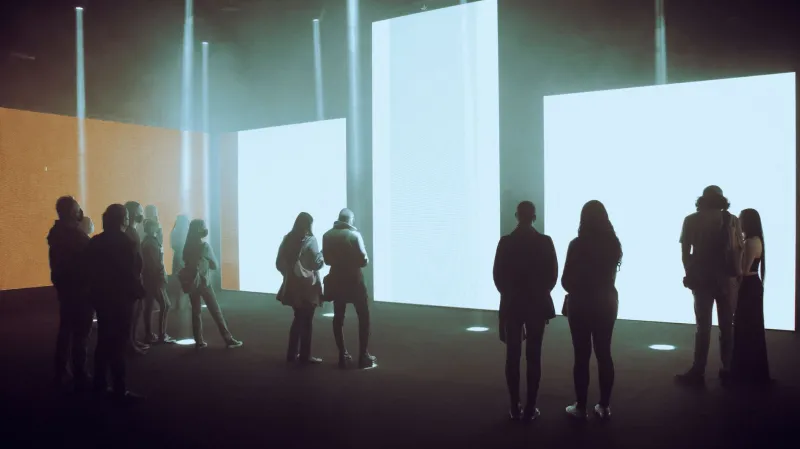
But the most compelling practitioners are not stopping at accurate prediction. Artists like Portland-based collective Watershed Signal have built installations in which a trained model's forecast is displayed alongside actual water behavior, projecting both onto the same surface simultaneously. The gap between the two—sometimes a hairline fracture, sometimes a dramatic divergence—becomes the work itself. Viewers are invited to read that gap as a kind of argument: between order and entropy, between what science promises and what nature delivers.
"We're not interested in the model being right," one member of the collective has noted. "We're interested in the moment it's wrong, and what that wrongness looks like when you make it visible."
Neural Networks and the Chaos Threshold
What makes water particularly fertile territory for AI-assisted art is precisely its position on the boundary between predictable and chaotic systems. At low velocities and simple geometries, water behaves according to well-understood physical laws. Introduce turbulence, irregular surfaces, or competing forces, and the system becomes exponentially harder to model—even for the most sophisticated algorithms.
Several artists are exploiting this threshold deliberately. New York-based artist and researcher Dara Venn has developed a generative system she describes as a "chaos calibrator"—a neural network trained to identify the precise conditions under which water behavior becomes computationally intractable, and then to trigger those conditions in a physical tank embedded within her installation space. When the algorithm reaches its own limits, it signals the physical system to introduce new variables: a jet of pressurized air, a change in water temperature, a vibration transmitted through the tank's walls.
The result is an artwork that uses machine learning not to demonstrate mastery over water, but to locate and celebrate the exact point where mastery fails. Audiences report an almost vertiginous sensation standing before the installation—a feeling that the boundary between the digital and physical has become genuinely porous.
Responsive Environments and Living Works
Beyond the studio and the gallery tank, AI-assisted water art is increasingly moving into public and responsive formats. A number of artists are building installations that use environmental sensors to feed real-time data—local weather patterns, humidity readings, even seismic activity—into generative models, allowing the work to evolve continuously in response to its surroundings.
Chicago-based artist Marcus Osei has deployed this approach in a long-term public commission along the Chicago Riverwalk, where a series of projected water simulations responds to actual river conditions measured by sensors mounted on nearby infrastructure. When the river runs fast after rainfall, the projections grow turbulent and fragmented. During the still heat of midsummer, they slow to something approaching stillness. The AI model interpolates between states, generating imagery that is neither purely documentary nor purely fictional—a kind of speculative mirror held up to the river itself.
Osei describes the project as an attempt to "give the river a second voice"—one that can speak in forms inaccessible to direct observation. The machine, in his framing, is not replacing the water's expressiveness but amplifying it, translating physical behavior into visual language that operates at a different register of perception.
The Ethics of Algorithmic Water
Not everyone in the contemporary art world is persuaded that AI belongs in conversation with water's essential wildness. Critics have raised pointed questions about the environmental cost of training large generative models—a concern that carries particular weight when the subject matter is ecological. The computational energy required to run real-time fluid simulations is not trivial, and several artists working in this space have begun grappling publicly with the tension between their subject matter and their methods.
Some have responded by constraining the scale of their models, using smaller, purpose-trained networks rather than large general-purpose systems. Others have committed to running their installations on renewable energy, or to offsetting computational costs through partnerships with environmental organizations. The conversation is ongoing, and its presence within the artistic community suggests a level of self-awareness that distinguishes this movement from earlier, less reflective waves of tech-inflected art.
What the Algorithm Cannot Know
Perhaps the most philosophically rich dimension of this emerging practice is what it reveals about the limits of machine understanding. A neural network trained on water footage can learn to anticipate surface tension, to model the way light refracts through a moving body of liquid, to predict the spread of a ripple across a still pool. What it cannot learn—at least not yet—is what water means.
That gap between physical modeling and cultural resonance is where the most ambitious artists in this space are choosing to work. By building systems that are technically sophisticated but semantically open, they create conditions in which audiences must supply their own interpretive frameworks. The machine provides the structure; the human provides the significance.
In this sense, the AI-assisted water works emerging from studios across the country are less about technology than about perception—about training ourselves, as viewers, to notice what algorithms miss and to find meaning precisely in that absence. Water, it turns out, is an ideal medium for this investigation. It has been carrying meanings that exceed measurement for as long as human beings have stood beside it.
The machines are learning to flow. The artists are learning what that learning cannot touch.